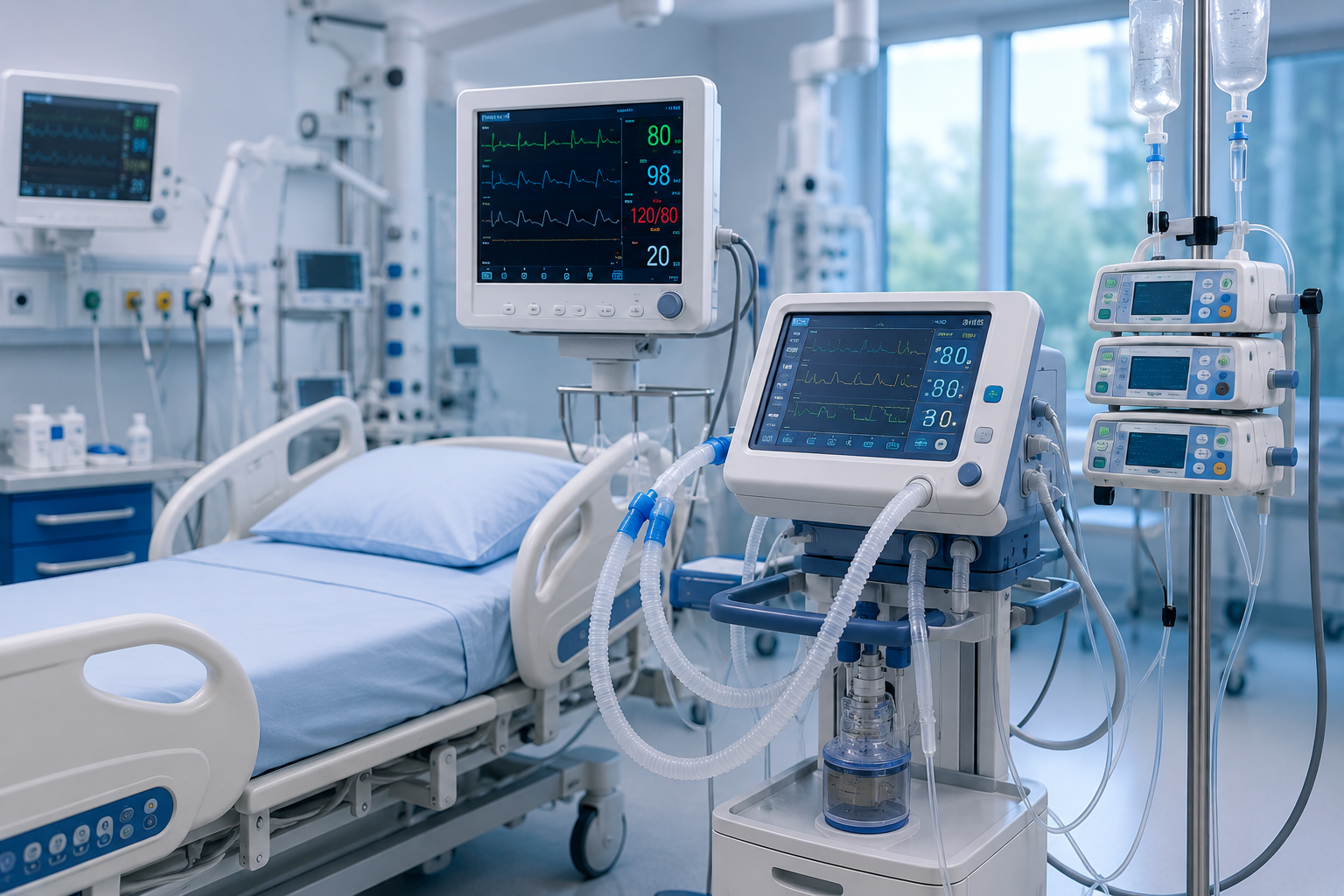
Walk into any functioning Intensive Care Unit (ICU) globally, and you will immediately notice the rhythmic hum and calculated alerts of three indispensable devices: the mechanical ventilator, the patient monitor, and the infusion pump. While they may not always dominate the conversation during high-level procurement meetings, remove any one of them, and the ICU instantly ceases to function as a critical care environment.
As healthcare infrastructure expands worldwide—including in rapidly developing medical hubs like Ghana—the temptation is often to focus simply on expanding bed capacity. However, adding beds without correctly specifying and integrating the right core technology creates a high-dependency room, not a functional critical care unit. Understanding exactly why these three devices matter, how they interact, and what your facility needs to support them is the foundation of any serious clinical investment.
What Separates an ICU from a General Medical Ward?
An Intensive Care Unit exists for a singular, highly specialized purpose: to support and sustain patients whose bodies can no longer maintain their own vital organ functions without continuous clinical intervention. In this environment, the margin for error is absolute zero.
A patient relying on mechanical ventilation who loses airway support for even a few minutes faces irreversible neurological consequences. A potent medication running at an incorrect infusion rate can trigger a fatal hypotensive crisis. A subtle physiological deterioration that might be manageable if caught within an hour on a general ward is often unrecoverable in the ICU.
This is exactly why these three core devices cannot be viewed as optional upgrades or negotiable budget line items. They represent the absolute minimum clinical standard that defines critical care.
Mechanical Ventilators: Sustaining Respiratory Function
A mechanical ventilator takes over the complex mechanics of breathing for patients who cannot sustain adequate gas exchange on their own. This encompasses patients recovering from major cardiothoracic surgery, those in acute respiratory distress syndrome (ARDS), individuals with severe pneumonia, and patients requiring deep, prolonged sedation.
Precision Airway Control
Modern mechanical ventilation is no longer just about pushing oxygen into the lungs. Today’s advanced ventilators deliver incredibly precise tidal volumes and positive end-expiratory pressure (PEEP). This precision is vital for preventing both under-ventilation (hypoxia) and structural lung damage caused by excessive pressure, known as barotrauma or ventilator-induced lung injury (VILI).
Adaptive Respiratory Support
High-quality ventilators adapt in real-time to changes in a patient’s lung compliance and airway resistance. By continuously monitoring the patient’s spontaneous breathing efforts, the machine can synchronize with the patient, easing the eventual weaning process and significantly reducing the time spent on life support.
The Absolute Need for Uninterrupted Power
Grid fluctuations during ventilator-dependent care are an immediate, life-threatening patient safety risk. Ventilators must be sourced with robust internal battery backups, and your facility’s electrical infrastructure must be rigorously tested. Utilizing professional Engineering Services for a pre-installation site assessment ensures your power grids and medical gas lines can safely support uninterrupted ventilation.
Patient Monitors: The ICU’s Continuous Early Warning System
A patient monitor does not actively treat the patient. Instead, it provides the clinical team with the continuous, real-time data required to make rapid, accurate, and life-saving decisions.
In a high-acuity ICU, the patient monitor acts as an unsleeping second set of eyes. It allows a critical care nurse managing multiple complex cases to know the exact moment a patient begins to hemodynamically compromise, long before that deterioration becomes visible to the naked eye.
Beyond Basic Vital Signs
While general wards rely on periodic spot-checks, an ICU-grade monitor delivers continuous streams of data. A capable system must provide:
- Continuous ECG monitoring with automated arrhythmia detection.
- Both non-invasive and invasive blood pressure (IBP) monitoring capabilities.
- Pulse oximetry (SpO2) and capnography (EtCO2) for immediate respiratory status assessment.
- Core and peripheral temperature tracking.
Combating Alarm Fatigue
One of the greatest dangers in a modern ICU is “alarm fatigue”—a phenomenon where staff become desensitized to the constant beeping of medical devices, leading them to ignore or disable critical alerts. Premium patient monitors allow for highly customizable alarm thresholds. They alert staff to clinically meaningful physiological changes without generating constant, exhausting noise from minor, transient fluctuations.
Central Station Connectivity
Data from individual bedside monitors must flow seamlessly to a central viewing station at the nurses’ desk. This allows a single clinical supervisor to maintain visual oversight of the entire unit’s hemodynamic stability simultaneously.
Infusion Pumps: Precision Pharmacology That Cannot Be Left to Chance
The vast majority of ICU medications are delivered intravenously, continuously, and at potent micro-doses where even minor calculation errors carry catastrophic consequences. Vasopressors to maintain blood pressure, sedatives, analgesics, insulin, and continuous cardiac inotropes are not medications that can be safely approximated through manual drip counting.
Managing High-Alert Medications
An ICU-grade infusion pump—often called a “smart pump”—delivers fluids and life-saving drugs at a meticulously programmed rate. It ensures that a patient receives exactly 5 micrograms per kilogram per minute of a critical drug, without deviation, over a 24-hour period.
Dose Error Reduction Systems (DERS)
The safest infusion pumps feature built-in Dose Error Reduction Systems (DERS). These systems utilize pre-loaded drug libraries based on standard hospital protocols. If a clinician accidentally programs a dose that exceeds the safe limit for a specific medication, the pump will immediately flag the entry as a “hard stop” and prevent the medication from being delivered until the dosage is corrected.
Occlusion and Air-in-Line Detection
Advanced pumps feature highly sensitive pressure sensors that detect occlusions (blockages in the IV line) or dangerous air bubbles entering the tubing, immediately halting the infusion and alerting the staff before patient harm can occur.
Why These Three Devices Must Function as an Integrated System
A critical mistake facilities make is procuring their ICU equipment piece-by-piece from multiple different manufacturers without considering interoperability. A ventilator, a patient monitor, and an infusion pump stationed at the same bedside must coexist seamlessly.
Consider the friction caused when they do not:
- Alarm Conflicts: Three devices from different brands generating overlapping, discordant alert sounds create a chaotic acoustic environment, directly contributing to clinical burnout.
- Physical Clutter: Each device has specific mounting, spatial, and cabling requirements. Planned collectively, the bedside remains clean and accessible; procured individually, it becomes a hazardous tangle of wires.
- Service Fragmentation: When equipment inevitably requires servicing, dealing with three different manufacturers means three different response timelines, three separate service contracts, and no single point of accountability.
Procuring your core life-support infrastructure through a single, experienced partner removes this friction entirely. Explore a comprehensive ICU Equipment range to see how modern devices are designed to integrate effortlessly into a cohesive clinical ecosystem.
Facility Readiness: Preparing for Critical Care Deployment
Even the most advanced ICU equipment will fail in a facility that is structurally unprepared to support it. Before finalizing any procurement, hospital administrators must confirm the following:
- Redundant Utilities: Uninterruptible Power Supply (UPS) systems must be capable of sustaining all three device types simultaneously during extended grid outages. Medical air and oxygen lines must deliver consistent, calibrated pressure.
- Verified Staff Competency: Equipment is only as safe as the clinician operating it. Competency in ventilator modes, monitor configuration, and smart pump programming must be validated before patients are admitted. A structured Installation & Training program bridges the gap between hardware delivery and clinical readiness.
- Proactive Maintenance Strategies: A breakdown in the ICU is a medical emergency, not an inconvenience. A proactive Operation & Maintenance contract ensures that preventive servicing happens on schedule, minimizing unexpected downtime and protecting your financial investment.
An empty room filled with specialized beds is not an ICU. True critical care capability is defined by the facility’s ability to sustain life when the human body can no longer do so independently. That profound responsibility relies entirely on mechanical ventilators, patient monitors, and infusion pumps that are correctly specified, seamlessly integrated, consistently maintained, and operated by a highly trained clinical team.
If your hospital or diagnostic center is planning a new critical care setup or upgrading an aging high-dependency unit, expert guidance is paramount. Partnering with a trusted Medical Equipment Supplier ensures every device works as part of one cohesive system rather than a fragmented collection of parts. Contact us today to speak with medical equipment specialists who can help you build a cohesive, reliable ICU infrastructure ready to deliver the exceptional standard of care every critically ill patient deserves.
.
FAQs
- What is the standard lifespan of ICU core equipment? With proper preventive maintenance, high-quality ventilators and patient monitors generally have a clinical lifespan of 7 to 10 years. Infusion pumps typically require replacement or major recalibration every 5 to 7 years due to the constant mechanical wear on their internal pumping mechanisms.
- How do “smart” infusion pumps differ from standard IV pumps? Standard IV pumps simply push fluid at a programmed rate. Smart pumps feature Dose Error Reduction Systems (DERS) and integrated drug libraries. They act as a computerized safety net, preventing clinicians from accidentally administering a fatal overdose of high-alert medications.
- What causes alarm fatigue in the ICU, and how can it be prevented? Alarm fatigue occurs when clinical staff are exposed to a high frequency of alarms—many of which are false or non-actionable—causing them to become desensitized. It can be prevented by investing in advanced patient monitors that allow for individualized alarm thresholds and intelligent alert delays for minor, self-correcting physiological changes.
- Why is capnography (EtCO2) essential in modern patient monitoring? While pulse oximetry (SpO2) measures oxygen in the blood, capnography measures the carbon dioxide exhaled in every breath. It provides an immediate, breath-by-breath picture of a patient’s ventilatory status, instantly alerting staff if an airway becomes obstructed or a ventilator tube dislodges, often minutes before oxygen levels begin to drop.